
Employee vs. Subcontractor: What Every Contractor & Trades Owner Needs to Know Before the IRS Decides for Them

Written by Crystal Prado
It’s one of the most common — and most expensive — mistakes in the trades industry. You bring on a helper, a specialist, or a crew to cover a busy stretch. You pay them per job, they use their own tools, and at the end of the year you hand them a 1099. Simple, right?
Not always. And if the IRS or your state labor board disagrees with how you’ve classified that worker, the consequences can be significant: back taxes, penalties, and in some cases, personal liability.
Here’s what you need to understand before your next hire.
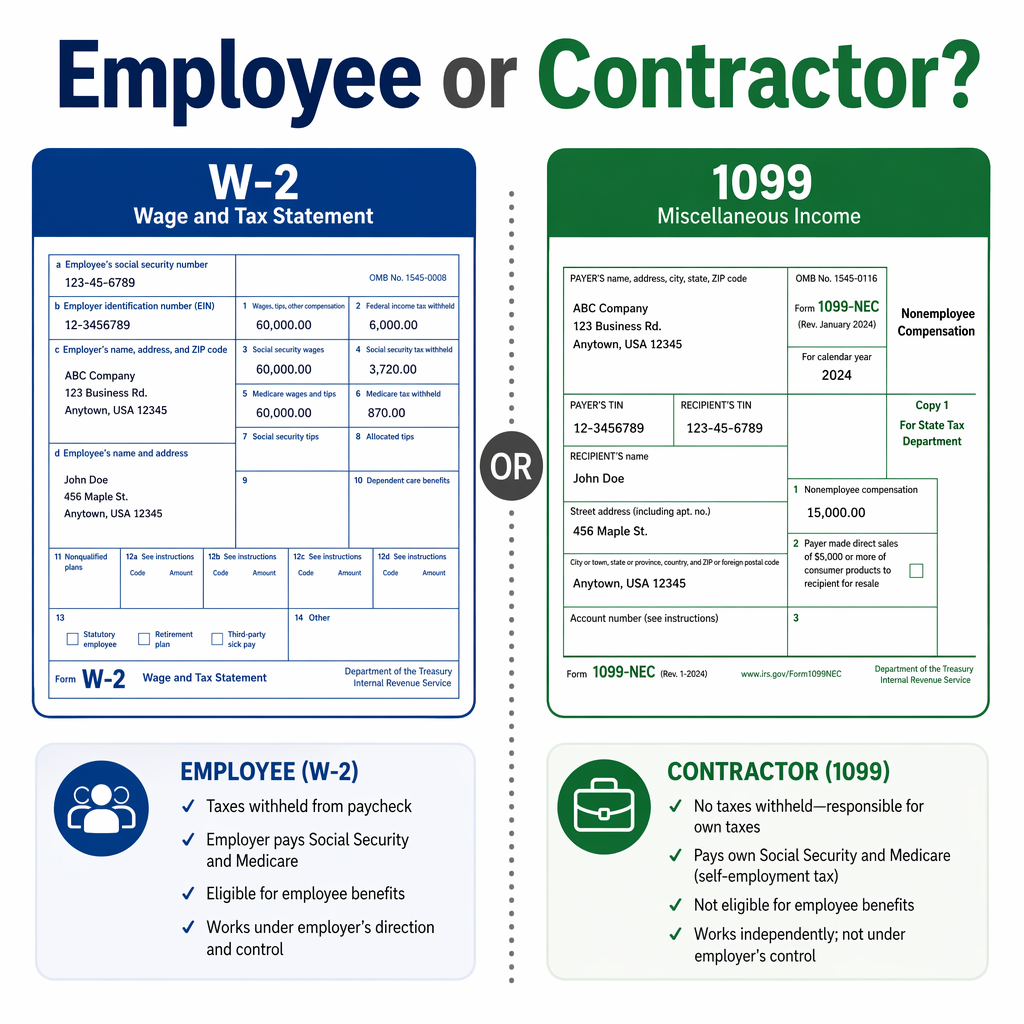

Why This Matters So Much in the Trades
Trades businesses — plumbing, electrical, HVAC, general contracting — rely heavily on flexible labor.
You need more hands during a big commercial build. You need a licensed electrician for one phase of a job. You need a framing crew for three weeks and then they’re done.
That flexibility is a huge operational advantage. But it creates real risk if the workers you’re calling “subs” don’t actually meet the legal definition of an independent contractor.

The IRS Doesn’t Care What You Called Them
The IRS uses a multi-factor test to determine whether a worker is truly an independent contractor or whether they should have been classified as an employee. It looks at things like:
- Behavioral control — Do you control how the work is done, not just the end result?
- Financial control — Does the worker have their own business expenses, serve other clients, and set their own rates?
- Type of relationship — Is there a written contract? Do you provide benefits? Is the work ongoing or project-based?
Here’s where trades businesses often get into trouble: if you’re directing a worker’s daily schedule, supplying their tools or materials, and using them exclusively for months at a time — that starts to look a lot like employment, regardless of what your agreement says.
The label on the contract doesn’t control the classification. The actual working relationship does.
The Real Cost of Getting It Wrong
If a worker is reclassified from a 1099 contractor to a W-2 employee — by the IRS, your state labor board, or through a workers’ comp audit — here’s what you could be on the hook for:
- Employer-side payroll taxes (Social Security, Medicare) you should have been withholding
- Unemployment insurance contributions
- Workers’ compensation premiums
- Penalties and interest on unpaid taxes
- Potential back pay for overtime if they worked long hours
These costs can add up to tens of thousands of dollars — often more than the savings you thought you were getting by classifying them as contractors.
Signs Your Sub Might Actually Be an Employee
- They work for you exclusively (or almost exclusively)
- You set their daily schedule and tell them where to show up
- You provide the tools, vehicle, or materials they use
- They’ve been working with you continuously for months or years
- They don’t have their own contractor’s license or business entity
Signs Your Sub IS a True Independent Contractor
- They have their own business (LLC, sole proprietorship with a separate EIN)
- They carry their own liability insurance and workers’ comp
- They set their own schedule and decide how the work gets done
- They work for multiple clients, not just you
- You have a written contract that outlines the project scope and completion terms
What You Can Do To Protect Yourself
You don’t have to stop using subcontractors — you just need to do it right:
- Always get a signed W-9 before the first payment
- Collect proof of their business license and insurance (and keep it on file)
- Use written contracts that describe the project, not an ongoing employment relationship
- Avoid directing the day-to-day work — focus on the outcome, not the method
- Issue 1099-NEC forms by January 31 for any sub paid $600 or more in the year
And critically — have a bookkeeper or accountant who understands the trades review how you’re classifying workers before tax season, not after.
We help trades businesses stay compliant with worker classification and payroll. Let’s make sure you’re protected — reach out for a free consultation.